The Linguini Ballroom is a black and blue champagne glass the bubbles being elevators to space the crystal reflections being the light the people spinning lovely my heart-wrenching demise — the parquet floor of time is a long-bedazzled square of lines and rituals carved in it greasy secret codes and polished roadmaps to secrets and sand one must step lightly on the floor for it is slick and one could slip spilling their brains all over the barn — I had to get outside the Linguini Ballroom sit on a bench smoke some rope try to get my heart to stop beating it’s wrinkling my roughshod tux looking like my little green jeans muddy and torn as I spun like a wheel on the oceanside roundabout years ago… Before the wind dragged me back inside the Linguini Ballroom and the liquid slide and the rhythm of the jazz is all hyped up and pounding the feet are all slapping the floor dreary teeth are spitting limbs are making me dizzy, the way they spin is so criminal and I pound my fists against the gold, velour wallpaper and it’s soft like cloth and no one can hear me begging to escape from the madness of the Linguini Ballroom — and a cold mountain of snow crowned by a ring of trees comes to my aid ever so suddenly and it’s depression on snowshoes looking for an ice spear to shed a tear across blue-black veins freezing and down the hill rests a little town and the sign says Damnation and it’s straight to the whiskey bar I go like Jim and family portraits are nothing but piss and winter sweat and I drown in the rollback stitches tearing down my spine… And someone taps my bowed head seems I’m back at the phone booth cradled behind the glass to keep the mad steps away swirling lavishly beneath bee lights of the Linguini Ballroom dripping cancer and JFK — eyes drooped so low I push the doors aside and take my stride to the gun cabinet tucked neatly back in the Linguini Ballroom vault reach out for a magnum sunflower a golden crown of velvet peace take my stance on the mossy drawbridge and blow all the wishes from the stage, to send the spores to Heaven’s edge.
He watched her from the safety of a window inside as Gracelyn poked at the worn strip of earth below the swing with the tip of a shoe. She slowly swayed in the cool air of the playground, oblivious. Her thoughts were listless, yet on fire. She gazed into the emptiness around her and then bit into a hard apple she had plucked from a tree near the schoolyard. It tasted too sour in her mouth, and she threw it.
Astron Puffin turned away from the window and went to stand before the corkboard in the art classroom where he admired Gracelyn’s crayon drawing of her pastoral life. His eyes slowly scanned every sloppy detail — the clear-blue sky that was too blue, the camel hump green hills that lacked realistic detail, the crooked house in the middle of a field, the lake that was unnaturally circular, the red lighthouse she left structurally unsound.
He smiled and laughed to himself. Then he reached out, tugged the drawing away from its place beneath the pin, folded it, and stuffed it into his pants pocket before going outside.
He walked boldly to the playground, her back turned to him as she floated in the air atop the swing. He said nothing when his hands grabbed the chains and drew her back like an arrow on a bow. She screamed when the hands released her, and she shot forward. When she swung back, the hands pushed against her lower back, and she swung forward again. She struggled to twist around to see who it was. Then again, the hands pushed against her back with more force than before.
“Stop!” she cried out. And again, the hands pushed against her when she swung back, but this time, Gracelyn jumped off before going too high.
“What are you doing!?” she screamed out, tangled up in a cloud of dust on the ground.
Astron Puffin was startled by her reaction. “I was just giving you a push. You looked sad. I thought that you might like to go high on the swing.”
“You scared me half to death!”
“I’m sorry.”
“You shouldn’t sneak up on somebody like that… It’s unsettling.”
“I’m sorry,” Astron repeated. “I didn’t mean to unsettle you. I thought we could be friends… It’s such a lonely place, don’t you think?”
Gracelyn huffed in frustration as she got up and brushed the dirt away. “Why are you still here?” she wanted to know, stern in her tone. “Why do you keep following me? Can’t you just leave me alone!?”
Astron froze for a moment. He didn’t answer her. He couldn’t answer her — no thought that made sense came to his mind quick enough.
“Well!?” Gracelyn demanded.
He turned away from her and ran off.
“Wait!” Gracelyn called after him. “I’m sorry. I didn’t mean it like that.” Then she watched him get smaller on the horizon until his body completely vanished beyond the edge of the dark woods.
Gracelyn meandered as she rode her bike back home from school. She looked up at the sky. The sunlight was dying earlier every day now. Summer was over for good, and the Earth was moving toward autumn. “At least in this part of what’s left of the world,” Gracelyn reminded herself. She slowly shook her head. “I’m getting very bad at talking to myself. I should find myself a doctor of the mind.” She laughed at the absurdity of that thought.
When she got back to the big white farmhouse she called home, she lazily dropped her bike in the yard, scrambled up the steps and went inside. She immediately locked the door behind her and went around the house lighting a cathedral’s worth of candles. Moses came out of his hiding place, twisted around her legs, and demanded to be fed by means of loud, repetitive meows.
“All right, all right. At least let me catch my breath and get situated,” she said to him. Then something caught the attention of her mind, like an invisible tapping on the shoulder, and she slowly walked around the house to investigate the feeling. Gracelyn carried an LED lantern that swung on hooks attached to a handle to light her way. She didn’t like the lantern as much as she did the candles. The light of the lantern was too harsh, too bright, too cold, but it was the best way to crawl through the darkness that fell upon the house in the deep of night.
She poked her head in all the rooms on the first floor — the living room with the old furniture, musty drapes, and cabinet TV; the front parlor with its large bay windows; the study with its shelves full of books now dismantled by technology — before going up the stairs to where the bedrooms and a bathroom were. She stood in a long hallway and held the lantern out in front of her. All the doors to the rooms were closed despite the fact she always left them open. She went to the door of her bedroom and pressed the side of her head against it and listened. Once she was satisfied there were no sounds inside, she reached for the doorknob, turned it, and went in.
Gracelyn was startled to see that the doors to her closet had been thrown open and now all the clothes she had inside it were piled on her bed. “Robbers searching for something,” she breathed. “Or lunatics.” The air in her room felt cold and she looked and saw that her bedroom window was open. She went to the sill and peered out, but the gathering darkness provided no clues as to who or what had entered the house. “Someone is trying to trick me,” she said to herself. “Or at least scare me.”
She sighed, uneasy. Gracelyn reached up and pulled the window down tight and locked it.
When she returned to the kitchen, she cranked a can opener around the top of a can of cat food and plopped the factory churned seafood delight into a bowl. Moses didn’t wait for her to set the bowl on the floor but instead jumped up on the counter and ate right there. Gracelyn stroked his fur as he gobbled up the food.
She let Moses be and went out the back door that was off the kitchen and walked into the backyard. A screen door with a spring that croaked like a frog when it was stretched slammed behind her. Tall trees fenced in the yard on three sides. An opening to the left led to an old barn and the fields and wilds beyond. Gracelyn went to the firepit she had constructed out of stones, added a few new sticks and small logs, then lit some crumpled-up paper beneath the wood with a Bic lighter until it caught and spread. Once she had a lively fire going, she stood there for a moment, mesmerized by the orange light and the soft crackling of sticks and the sizzle of sap.
Dusk was retreating and full night was coming on and with it the first few lights in the heavens flickered to life. She looked up, hoping to find something she could wish upon. But she gave up quickly because the heaviness of the world came upon her again like it so frequently did. She looked back at the house and the gently shaking soft orange glows of the candles in the windows. She saw a silhouette of Moses, licking a paw and washing his face just beyond the screen door. She tried to smile but found it hard. The thought that someone had possibly been inside the house frightened her. Then she realized she had forgotten to look in the basement. It was too dark for that now, she decided.
She looked up again at space. “I can’t stay here forever,” she said to the sheet of stars unfurled across the night. “I need to find a way to get out. I’m afraid.”
Gracelyn spun around and pressed her back to the counter. Her heart started thumping inside her chest, lit up with fear. “Who said that? Who’s there?” she called out.
The door to the stall slowly opened with the squeak of a metallic mouse. A small man, husky, and with a very round face emerged. There was some gray in his hair that was creeping out from beneath a crooked pointed winter knit cap that sat upon his head. The salt and pepper scruff on his face was uneven, choppy like a soured sea, as if he had used a dull butcher knife to shave. He had a lot of wrinkles around his cold blue eyes, the skin like rivulets streaming in from somewhere beyond his temples. He looked tired, Gracelyn thought, but not overly threatening. “Who are you?” she asked.
“The name’s Astron Puffin,” he said, and he spoke with an accent, like from the Old Country on the other side of the planet.
As he grew closer, Gracelyn saw that his skin had an almost pale-green hue to it, like he had been washed in over diluted watercolor paint. “Are you sick?” she wanted to know.
“No. I’m not sick at all. I swear it. Would I even be here if I was?”
“Right. Here. Then why is it you’re in the girls’ bathroom? I’ve never seen you around school before.”
The man looked around at all the pipes and pink and porcelain, confused, as if he had just discovered where he was. “I don’t know. I just figured it might be the safest place to be at the moment.”
He stepped forward and Gracelyn shifted away from him. “I’m not going to hurt you,” he assured her. “I just wanted to wash my hands.” He was not much taller than she was, but definitely wider. “I’ve never hurt anyone in my whole life. Yet here I am, left to suffer alone in a world such as this.”
“You said you thought my speech was wonderful. How did you hear my speech?”
“I was hiding outside an open window, near your classroom,” he said, shaking water from his hands and then rubbing them against his clothes to dry them. “And even the softest voices carry far in this weight of silence.”
“Have you been watching me? Following me?” Gracelyn demanded to know.
Astron Puffin turned his moon-like and pale-green face away from her. “You’re the first person I have seen in a very long time,” he shyly said. “Please don’t be upset. I was just trying to make sure you weren’t evil. I suppose I’ve decided you aren’t.”
“You’re right. I’m the farthest thing from evil, most of the time,” Gracelyn pointed out. “But where did you come from?”
“I had my own cabbage farm, far over the hills to the west. The nights grew to be too long and lonely and much too dark. I set off to see if I could find someone else. To keep madness at bay… And that’s how I came upon you.”
Gracelyn hesitated for a moment and then moved toward the door. She quickly turned to look back at him there. She was scared yet felt pity for him. “It was nice meeting you, however strange of a meeting it was, but I really should get to my next class before I’m late,” she said.
Astron looked hurt. “Oh. All right, then. I shouldn’t keep you from your lessons.”
“Maybe I’ll see you around again, somewhere,” Gracelyn added, in an effort to give him a small bit of hope for whatever future he had.
Astron attempted a smile. “Yes, perhaps. I’d like that. Good luck with your schoolwork… What was your name?”
The girl hesitated for a moment. “Gracelyn,” she said, and she went out of the bathroom and into the dead hallway that glistened with lonely solar energy falling across the plains of the universe.
Gracelyn sat alone in her art classroom. She reached into a box of crayons and retrieved a periwinkle blue. She held it under her nose and smelled it deeply. “I just love the scent of a fresh crayon,” she said to the quiet air. Then she applied the tip of the crayon to a blank sheet of drawing paper and moved her right hand back and forth until a sky appeared.
She then retrieved from the box two shades of green, a burnt umber, and an earthy yellow to draw the hills, forests, and fields that surrounded her home. She mixed white, and gray, and black to construct the house. She grabbed a darker shade of blue to color in the lake and used the gray and black again to create a stone pier. Finally, she grabbed brick red to create a lighthouse that sat tall at the tip of the pier, and silver to add a shiny light that looked out all around the world.
When she was done, she held the drawing in front of her and looked at it. She cocked her head to the left and studied it more intently. Once she was satisfied with it, she signed her name at the bottom in bright orange — Gracelyn Polk, sixth grade, 413 years old. She then got up and walked her drawing to the front of the classroom, turned to face the empty desks, and held it up for no one to see.
“This is my drawing of where I live,” Gracelyn began — speaking much more confidently than she did in her history class earlier — and then she pointed with a finger. “This is my beautiful house. I live in the country, surrounded by lovely green hills and trees and golden-brown fields. It’s all very pastoral — that means being peaceful in the lands beyond the broken cities. Further off, you can see the great lake, and there’s the lighthouse with its bright beacon guiding safe passage for all… Thank you.”
Gracelyn turned and stuck her drawing to a corkboard with a push pin. She went back to her desk, put the crayons back in their box, and put the box back into a wine-colored cubby hole in the cubby-hole cabinet near the front of the room. She looked up and saw the big poster that showed the map of the entire world. Her eyes scanned it for a moment. There were so many red Xs drawn over so many countries. She sighed with faint hope, faint promise. She pulled the classroom door open, walked the somber corridors alone, and went to the playground for another desolate recess.
I was sipping nihilistic karma from a chipped cup on a hillside overlooking a rainy funeral dirge, the silver trumpets blared, the dead one stared from out of the center of the box with locks that held his corpse in nice and tight
The rain washed over me, soaked me as the gloomy troop marched through the slop and the joy boys lowered the casket with clumsy speed. My finger slipped directly against the chip, a moment of clumsy stirring the blood mingled with the nihilistic karma my blood mingled with the rain and I ran to the nearest club for a warm wet towel and a cascade of hermit vibes
I sat at the bar, and it was like Saturn, rings of smoke swirling and twirling with the rhythm of the chocolate clocks Gender-fluid barflies drowning in warm wet circles dialing up centrifugal force against the grain, and the rain came down like rubber sheets spilled in through a shadowy doorway, a stranger stepped through shook like a dog coughed out a fog and motioned to the nearest conflagration
I turned away and sang a song to the barfly maidens, a song I had heard a while ago where they buried the man so far below, they laughed and pawed tore the coat from my back and I ducked away to the nearest coma, a dirty carnival rambling rough a hidden room way off from here a place of stone idols bathed in the grasp of spindly limbs blindly grasping beneath a wet canopy of gold and green scattered across the stratosphere
And when the midnight shook through the glass hallways of this dream all my hopes and desires became breathless and tight I wanted her below me creamy and shocking bellyaching in the limelight of this nightmare life, flicking ashes on a wet lawn hours before another stifling dawn, the moon cradled in such a tilt as I screamed out the agony of my loving guilt.
Gracelyn Polk sat at her desk in the middle of her world history classroom at Cabbage Junction Primary School. She was fidgety and nervous and chewing on her nails like she knew she shouldn’t. But she couldn’t help it. She hated giving speeches. Hated it so much. She softly sighed. “I’d rather eat tree bark if I had the choice,” she quietly said to herself. The thought bounced around in her head like a pinball, echoing like a steel drum off the sides of her inner skull. She took a deep breath and exhaled. She tapped her papers on the desk to align them neatly, and then got up and walked to the front of the classroom.
She nervously shifted as she stood there, eyes cast downward, which she knew wasn’t the right thing to do when giving a speech. The papers were rattling in her hands. A large green blackboard behind her displayed the words Avoid the Dream in powdery white chalk. She cleared her throat and pushed her hair back away from her face. She glanced toward the windows to quickly see what it was like outside — wishing she was there. Leaves danced in an invisible breeze. The sky looked like aluminum rubbed raw by the hard-working hands of God. The papers containing her speech suddenly slipped from her hands and floated down to the floor in a scrambled mess. She quickly bent down to retrieve them, struggling to get them back in order. Her stomach was sick with embarrassment. She composed herself and tried to stand tall. Her lips trembled as she finally began to speak, but her head was down, and she was simply reading what she had written on the sheets of paper.
“In my quest to make the world a better place, my important invention would be a soda pop aqueduct. To help me with this all-important project, I would conjure up the spirits of Roman engineers as my historic guides.
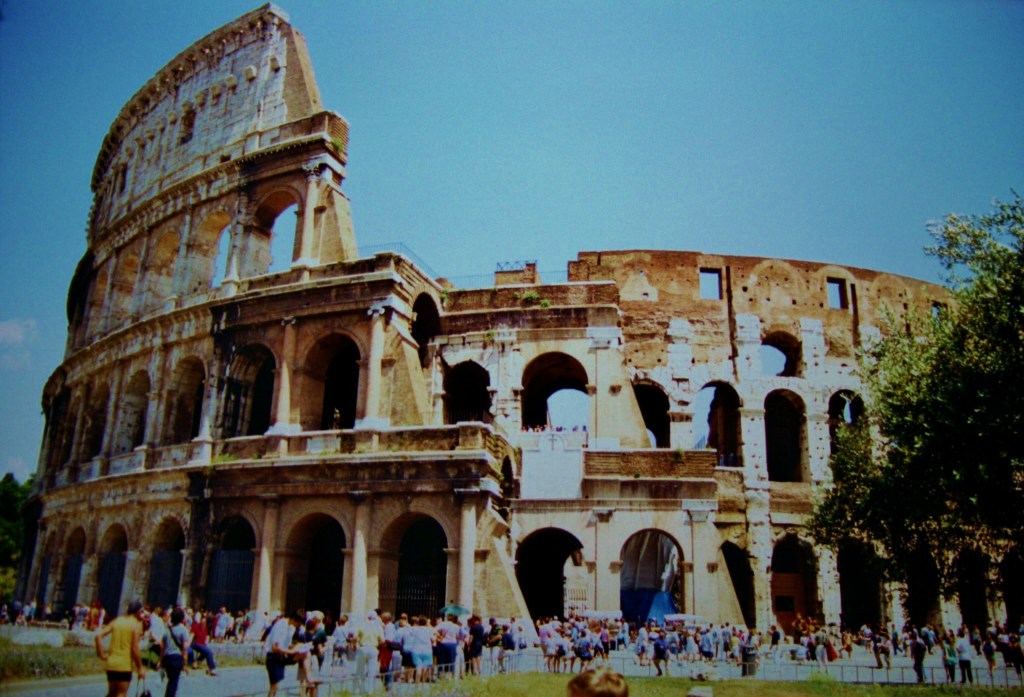
Roman engineers were very smart and created some of the greatest engineering feats in history — many of which remain to this day. Examples of this would be The Colosseum in Rome, which is in Italy, and one of my favorite places to travel to… Not only for the history, but the cute boys and delicious gelato as well.”
Gracelyn’s laugh that followed was awkward and insincere. It was supposed to be a funny little joke, she thought, but no one was laughing. Inserting a bit of humor into an otherwise tedious speech was supposed to be a good thing, she debated in her seasick head. Wasn’t it? She cleared her throat and quickly bent her head down to continue reading.
“The Imperial Baths of Trier in Germany are another fine example of Roman ingenuity and architectural prowess. They are believed to have been built in the 4th century and are a testament to how important bathing was to the ancient Romans. The site is said to have been capable of hosting thousands of bathers. Eww. I don’t think I’d want that many people with me in my bathtub.”
Again, Gracelyn’s attempt at interjecting humor into her speech was unsuccessful. Her nervousness grew. Her voice became shakier.
“Moving on. My favorite ancient Roman site and the inspiration for my idea for an important invention, is the Pont du Gard in France. The Pont du Gard is a huge three-tiered aqueduct bridge that was used to help transport water in the olden days from the town of Uzès to Nîmes — a distance of about 30 miles to us. The aqueduct dates back to around 19AD. If you’re ever in France, check it out.
The reason I’d want to build a soda pop aqueduct would be so that everyone has equal access to soda pop. I think soda pop is delicious and I’m sure many other people do as well. Soda pop makes me happy, especially in troubled times of personal struggle when I sometimes feel that I just want to throw myself off a cliff… Or the Pont du Gard for that matter. The bottom line is, my invention would bring happiness to all people — regardless of race, sex, age, religion, ethnicity, gender identity or who we love… And isn’t that what we should all be striving for?”
Gracelyn looked up from her papers and her muddied golden eyes slowly scanned the rows of empty desks in the silent classroom. She suddenly felt horribly sick to her stomach, dropped her speech, and dashed out of the room.
Gracelyn ran down the empty, polished hallway lined by orange lockers and bloodied bulletin boards until she reached the girls restroom. She slammed through the doorway and quickly made her way into one of the stalls where she dramatically threw up.
She steadied herself with her hands against the sides of the cold stall, her head bent over the toilet, her mouth dripping. She was breathing so hard, almost like a dog on a sweltering summer day. Tears began to roll down her face as she tried to tamp down the sick feeling inside her. She shakily reached for the flush handle and pushed it down. There was a loud swirling swoosh.
She went out of the stall and to the line of sinks. She turned on the discolored water, filled her hands and splashed it over her face. She forced some into her mouth, rinsed, spit. Gracelyn looked at herself in the cracked mirror and it made her look distorted… “But I am distorted. In so many ways,” she mumbled to herself.
It was silent for a moment, and then someone said from one of the other stalls, “I thought your speech was wonderful.”




 CEREAL AFTER SEX