Author: Aaron Echoes August

  • The Gravy Canoe of Wild Wyoming – 11

    Photo by Pixabay on Pexels.com

    The Gould house smelled like Sunday dinner and the trappings of commercialized religion. The house itself was one of the large old Victorians that rose like a classic architectural sentinel on the north side of town near the overlooking cliff rock and the only considerable clusters of trees in the whole of Berlin, Wyoming. It was often dubbed the “green side” of town because that’s where the main city park and the walking trails and the cemetery were, and where the little green men from space lived in their log cabin commune.

    The homestead where Carrie Gould and her mother lived was a tall, gaudy pink and white haunted candy palace with a nice kept yard full of colorful flowers. The interior was tidy, but gaudy as well, flooded with knick-knacks and bric-a-brac and portraits of white Jesus in a doctor’s gown, and soft sheep, and framed cross-stitch Bible verses on the walls. But still, there was a flip chill in the air, an icy bastard lingering in the shadows.

    Despite all the clutter, the house was warm and inviting. The furniture was soft and friendly. The windows were clean and clear. The intentions of the after Sunday service meal, however, were not.

    Pastor Craig Stikk and Steel Brandenburg III sat in the front parlor part of the house sipping coffee in an uncomfortable silence as they waited for the meal to be served. There was a heart of cruel intent in the room and Steel put his hand to his chest to feel if it was his own. He wasn’t sure it was. Intent. Intentions.

    Then the pastor asked. “So, Steel. What are your intentions with our lovely Miss Carrie?” He sipped at his coffee annoyingly, his black jellybean eyes searching above the tipped brim of the cup as he waited for an answer.

    “I’m not sure, pastor. Our relationship has just begun. We’re exploring each other,” Streel said, and he smiled to himself deep inside.

    But the pastor frowned at his remark, and then shifted. “And speaking of relationships… Do you have a personal relationship with Jesus?”

    Steel laughed. “No. He never returned my calls, so I dropped him.”

    A look of painful concern passed over Pastor Stikk’s perverted face. His pencil-thin moustache wriggled with distaste for the young man. “Steel. That’s not something to take so lightly. A personal relationship with your Lord and Savior is the most important thing in life. Do you not care to tend to your eternal soul?”

    “Look, I’m not religious. I never had a taste for it, and I certainly don’t want my face pushed into it.”

    “I’m not trying to push your face in it… I’m just saying that, well, Carrie is a very religious person, and don’t you think she should be with someone who shares in her beliefs? Don’t you believe she should be with someone who fosters and encourages her faith?”

    Steel drained his coffee cup and set it down. He looked straight across at the pastor and grinned his cocky grin. “You mean someone like you?”

    The pastor shifted in his seat and then leaned forward and whispered, “Frankly, yes. Life is too short not to be bold. I do indeed believe I would be a better mate to her, and I’m sorry if this offends you, but I don’t believe you’re good enough for her.”

    Steel scoffed. “I don’t understand why everyone in this town thinks I’m such a horrible person.”

    The pastor leaned away from him. “Well, maybe you are. Perhaps some deep personal soul searching is in order then, Steel. Other people obviously must see far deeper than you do. Personally, I’d be ashamed of myself.”

    “I don’t need everyone shaming me and telling me how to live my life. People need to stop being so damn judgmental. That’s what I can’t stand about religion—the self-righteous attitude. Did your God make you and everyone else God? And this whole pointless conversation boils down to one thing: You want to get with my girl. Gross. Aren’t you like 20 years older than her?”

    “I believe Carrie needs a mature man in her life,” the pastor said.

    “And that’s where you fit in?”

    “Steel, God spoke to me on this matter. The Lord Himself told me I should take Carrie as my own. Me. Not you. And I cannot disobey God. She will be mine, not yours.”

    “Well, I’m not going to just turn her over to you. I haven’t even gotten any action from her yet.”

    The pastor slapped a palm to his forehead in disbelief. “Good gravy, Steel. Must you speak of her in that way? It’s so disrespectful and Carrie doesn’t deserve it.”

    “Gravy?”

    “What?”

    “You said something about gravy… This is how this whole story started. Gravy.”

    “You’re rambling incoherently, Steel. ‘Good gravy’… It’s a term used when someone is expressing befuddlement… And you are befuddling me.”

    It was at that point that Mother Melba Gould came bouncing into the room. “Gentleman! I bring good news. Dinner is ready. Please come to the table.”


    The great Sunday feast was spread out on the large dining room table atop a precious cloth. They all took a seat and Melba called upon Pastor Stikk to lead the prayer.

    He stood, cleared his throat, and bowed his head. “Dear Lord, we ask that you look upon us with your everlasting grace and mercy as we prepare to enjoy this beautiful meal prepared by these two lovely women, your humble servants. We ask that we gain an understanding of and appreciation for your boundless gifts, such as these before us. Thank you, Lord, for this beautiful day and the opportunity for myself, Steel, lovely Carrie and Melba to come together in this beautiful home to commune with each other among these overflowing dishes. May we find sustenance and joy, and may this togetherness not only satisfy the hunger of our bodies, but also the hunger of our faith. Amen.” He sat back down, unfurled a napkin, and tucked it into his shirt collar. “Well, let’s eat.”

    Platters and bowls were soon being passed around as everyone filled their plates with tender pot roast and carrots, a green-bean casserole, mashed potatoes and gravy, niblets of buttered corn, a chilled spiral macaroni salad, beef noodle soup, spring rolls, sweet potato casserole, cheese chunks and crackers, fun fruit-filled gelatin, pickled beets and black olives, tapioca pudding, cranberry sauce, buttered rolls, wild rice pilaf, and goblets of iced tea, lemonade, and cold milk. Knives and forks and spoons quickly began to work, and they clinked against the Gould’s finest dinnerware as they moved like robots and the eating began.

    “Thank you, pastor,” Melba said with a smile. “That was a beautiful blessing over our table.”

    “It was my pleasure, Melba,” the pastor replied. “As you and your lovely daughter are a great pleasure to me.” He moved his hand beneath the table and squeezed at her thigh. Melba blushed and went “Ooooh.”

    Steel coughed and reached for a glass of moo juice and drank.

    “Everything okay there, Steel?” The pastor asked. “You seem choked up by something.”  

    “I’m fine. Thank you. Something just went down the wrong pipe.”

    “Pipe. Right,” the pastor replied with a sneer. “Speaking of pipe… Carrie, I was hoping you and Steel would start up some counseling sessions with me.”

    “Counseling?” Steel wondered aloud. “What for?”

    “Well, Steel. I often counsel young couples on the ways of Christian-based male-female relationships. It’s spiritual guidance really as you two walk with God along the path of love and eventually marriage.”

    “I’m not…” Steel began, but Carrie broke in after a quick, tight-lipped smile aimed at him.

    “We would love to, pastor. I think your guidance would be priceless. Thank you for offering.”

    “Not a problem. That’s part of what I do in my role as the lead shepherd for the congregation.” He chuckled oddly. “I must look over my flock.” He smiled big and then glanced over at Steel who was sitting across from him and next to Carrie. “I just want to be sure that God is always a part of your togetherness.”

    “I thought I made it clear to you in the other room earlier that I’m not religious,” Steel broke in. “I don’t want or need counseling in spiritual matters… Especially when it comes to our relationship. That’s our business, not yours.”

    Melba Gould’s mouth dropped open and some of the beef noodle soup dribbled out. “You’re not religious?”

    “Not especially, mam.” Steel answered. “The mountains of my life have never been moved much by faith.”

     The room was silent for a moment.

    “Well then, Steel,” the pastor said as he speared another slice of ham with his fork and put it on his plate. “Then you need it more than anyone.”

    Carrie grasped his hand. “It’s important to me, Steel. I don’t think I can carry on in this relationship if you’re not a man of faith. You’ll be amazed by what God can do for you if you just let him in.”

    Steel looked around the table. “You know, there’s such a thing as religious freedom. Meaning, I have just as much right not to be religious as you all have to be religious. And Carrie, baby, I just want you to accept me for who I am.”

    “And she has…” the pastor began, but Steel put a finger up toward his face. “With all due respect, pastor, this is not for you to decide.”

    “I beg to differ, young man,” the pastor snarled in return. “As a leader in the church, it’s my responsibility to watch over and guide her faith.” He slammed his fist down on the table. “It’s my God-given earthly task and I will not allow a non-believer to soil this beautiful young woman’s soul!”

    Steel stood and barked, “All you truly care about is getting in her pants! And I’m not going to let that happen!” He looked around at the shocked faces. “My apologies Ms. Gould. I think I’ll step outside for some air.”

    TO BE CONTINUED


  • Ms. Grundy and the Bone Ghosts (4)

    Allison Grundy stood in her front yard behind the safety of a white-picket fence and a grouchy demeanor. She had binoculars set against her sour face and she was watching the chorus of children playing out in the street and the neighboring yards. The song of stimulating play played up and down the roadway. “Damn, rotten kids,” she grumbled to herself. “So many damn kids. Who the hell is doing all this humping to make so many damn kids!?”

    There was a man behind her, and he was busy fixing the broken window on the front of the house from when someone threw a rock through it. “What’s that, Ms. Grundy?”

    “I wasn’t talking to you, Pascal,” she grunted without turning to look at him. She was too deeply focused in on the kids in the street.

    “Oh, sorry. How’d this happen anyway?”

    Ms. Grundy lowered the binoculars and turned around. “How’d it happen? See those damn kids clogging up the street?”

    Pascal turned and craned his neck to look. “Yeah… It was them kids that did it?”

    “That’s right,” she croaked. “One of them damn kids threw a rock and busted out that very window you’re fixing there. I could have been killed! Of course, none of the little shits came over to admit it or apologize or even offer to pay to fix it. They victimized me and now look at them… Playing around like little fantastical faeries.”

    Pascal sighed. “Little bastards. You know what the problem with kids these days is, Ms. Grundy?”

    “Oh, my. Please, Pascal, enlighten me with your what will surely be invaluable insight.”

    “Hey… If you don’t want to talk, just say so.”

    “No, no, no. I’m listening.”

    Pascal scrunched his face. He removed his company ball cap and wiped the sweat from his head with his sleeve. “Geez. It sure is warm today. What do you say when I’m done here, we go inside. I could sure use a cold drink… And we can talk some more. I can lay out my philosophy. I’m not just some window man, you know. I’ve got a lot of good ideas.”

    Ms. Grundy scowled. “That’s awful pushy of you, Pascal.”

    “I have confidence in myself. Is that a problem for you?”

    “No. Is my abrasiveness a problem for you?”

    “Hell no. I deal with assholes all day. Not to say you’re an asshole, Ms. Grundy.”

    “I appreciate that… All right, go on with your work and I’ll fix us a pitcher of my delicious lemonade.” She cackled to herself all the way into the house.


    Pascal Bravo the window man noted to himself that the house smelled of bitter oldness. He waited politely in a small parlor room with antique furniture, pleasant bookshelves, and a large window that looked out onto the world of rambunctious youngsters playing in the neighborhood.

    Ms. Grundy walked into the room carrying a trembling tray with a buxom pitcher of swirling lemonade with ice cubes and two inverted glasses. She set the tray onto a table and sat in the chair opposite him. She leaned forward, plucked up one of the glasses and poured. “I’ll let you do your own, Pascal. I’ll never be slave to a man.”

    Pascal smiled, leaned forward, and poured his own glass. “Thanks very much. I really like this room. You must enjoy reading.”

    “I do. When I have the peace and quiet. But again. Those damn kids. I was considering moving to a place of isolation on the outskirts of town… But I fear I’m beyond the ability to do so now. Too old. Too much work. I must come up with a better way to deal with all this commotion in the neighborhood… And violence! Like I told you, the rock.”

    “Well,” Pascal began, beaming with self-importance. “Like I was saying in the yard. The whole problem with kids these days is they have no discipline. And without discipline there’s no respect for others and what belongs to others.”

    “You speak the truth, Pascal. It’s the parents I blame, and the parents’ parents. They are far too busy with their own damn lives to care about what the children are up to. They just let them run wild like Indians.”

    Pascal cleared his throat. “I believe the correct term is Native Americans.”

    “Whooey!” snapped Ms. Grundy. “This is my house and I’ll use whatever god damn words I want to.”

    Pascal took a big gulp of the lemonade. “Ahh, that is tart, Ms. Grundy. But cold and refreshing just the same… But like I was saying. Kids these days get to do whatever they want. They have little to no guidance. No rules. No consequences for their actions.”

    “Right. No consequences,” Allison Grundy agreed. “And wouldn’t it be fun to give them some consequences? Hmmm, Pascal.”

    “What? Me? You want me to do something to those kids? Because that’s sort of the vibe you’re putting off. I’m not dumb. I have a very keen intuition.”

    “I’ll make it worth your while if you help me.”

    “What do you mean? Just what is it you plan to do to these kids?”

    “Your spine seems to be shrinking, Pascal. Tisk, tisk, tisk.” She wagged a finger at him while she took a gulp of the lemonade for herself.

    “I won’t kill anybody,” Pascal stressed. “Not for all the money in the world.”

    “I’m not talking about money or killing.”

    “No?”

    “No.”

    “Then what are you talking about, Ms. Grundy?”

    “Are you a married man, Pascal?”

    “No, but I’ve dodged the bullet a couple of times. I’ve given up on that scenario. Now I just do my work and go home to be alone. And you know what? I prefer it that way.”

    “You and I are very much alike then, Pascal. Very much alike… May I ask you something else?”

    “Sure.”

    “When is the last time you’ve had any sexual relations?”

    Pascal nearly emptied his mouth of the lemonade he had in it at that very moment. “What!?”

    “The last time you’ve done the ol’ in-out, in-out.”

    “Ms. Grundy… I think that’s a bit personal.”

    “Spill the beans, Pascal. When was it?”

    Pascal sighed. “If you must know. It’s been six years.”

    Ms. Grundy laughed out loud. “Six years!?”

    “Surely it must be something like 60 years for you!”

    “Zip it, Pascal… The point is, I could do for you, and you could do for me. And when we’re not messing around, we can be messing with those little brats out wandering the neighborhood. We’ll be a team.”

    Pascal stood up. “I’m not going to have sex with you. No way, no how.”

    Allison Grundy snickered. “I can guarantee in due time you will change your mind.”

    “I seriously doubt it.”

    “Come over here.”

    “What? Why?”

    “Pascal… Breathe. Just go with it.”

    Pascal stepped closer to her.

    “Drop your pants,” she ordered.

    He paused for a moment and then undid his belt buckle and let his Navy blue window man uniform pants fall to the floor. Allison Grundy looked him over and grinned. She poked at him with her finger. “Reminds me of a sea cucumber.” She looked up at him. “Let me see your cucumber.”

    Pascal scoffed in frustration, pulled up his pants and turned away from her. “No. This is too gross and weird.”

    “It’s okay, Pascal,” she said. “We’ve got plenty of time. But for now… Let’s figure out what we’re going to do about those rotten kids.”

    TO BE CONTINUED


  • The Cowmen (Two)

    Arno and Hosea came to a desolate town of squat adobe structures the colors of the earth and the sun and those structures mingled with freshly hewn wooden buildings that rose above them like intimidators and boasted of great possibilities. The rise of a new civilization on top of an old one was at work again in the world. The natives were being slowly crushed out by another generation from another place, and they believed they had the better of ideas and ways of living.

    The town’s name was Sudan and there was a smell of animal dung and sawdust and perfumed whores in the hot afternoon air. A wide dirt track went through the center of the town, and it and its immediate environs were lined on both sides and in the corners by the various modes of commerce and service: A bank, a jail, a general store, a hotel or two, saloons, a gunsmith, a livery stable, a butcher, a doctor, and a small train station with various people leaning or sitting as they waited upon their destinies to arrive on the rails.

    Horses and wagons moved like a meandering stream up and down the main thoroughfare which was mashed by hoofs and wagon wheels. As Arno and Hosea made their way along, some of the people nodded, smiled, said “hello mister.” Ladies in blooming dresses called out to them from balconies. Other folks with roughshod faces and rubber necks watched them closely and scowled with sour intent. Some even yelled out from the wooden boardwalks where they sat on barrels to warn them that they should “watch yourselves,” merely because they were drifting strangers.

    “I don’t understand why some folks need to be so hateful,” Hosea said as they worked the horses to a hitching post outside the Camaro Saloon. “I’m the nicest cowman in the world.”

    “Would you stop saying that!” Arno snapped as he climbed off his horse. “It’s so damn embarrassing.”

    “You’re always so worried about what other people think… I don’t care what other people think,” Hosea said. “I’m going to be who I am.”

    Arno rolled his eyes. “That’s probably your problem. Let’s get a drink, or 72… And try not to say too much.”

    Hosea waved his hand at the air. “Nah, you go ahead. I don’t feel much like drinkin’ and hollerin’ and carrying on right now. I think I just may go walk and stretch out these long legs of mine. I think that’s what I need.”

    Arno scoffed at him. “All right then. Just don’t get yourself in trouble.”

    “Look who’s talking.”


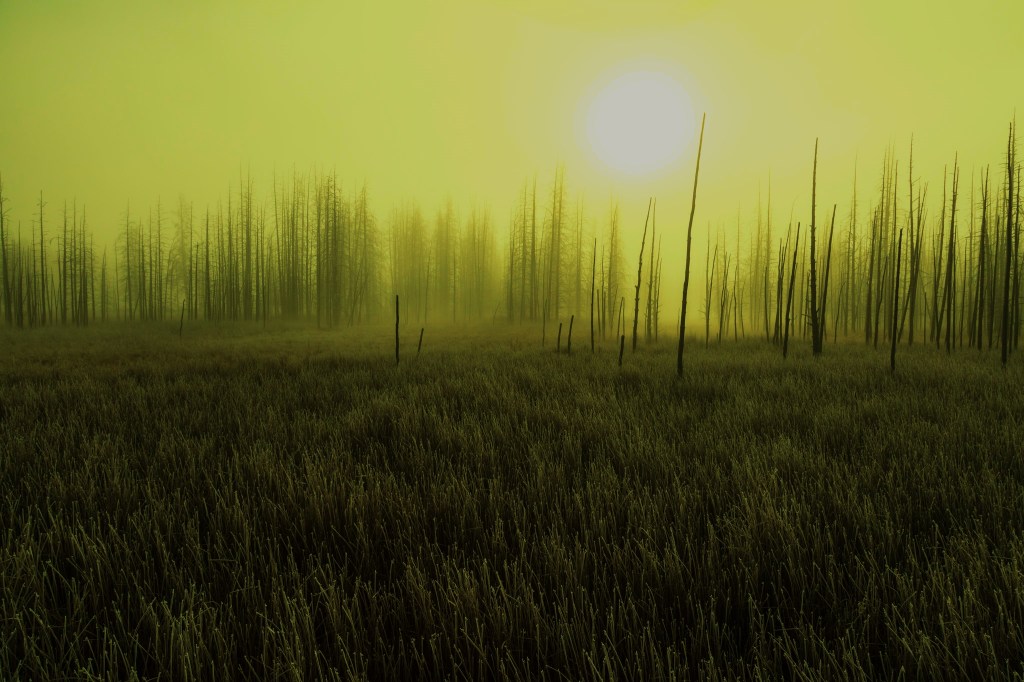
    Where Hosea ended up on his wandering walkabout was into a fog thick as gauze outside of the main part of the town, and there the birds were winged phantoms of dark light and the trees were backlit spindly bodies that leaned and coughed or sat away from all the others. The air all around was a mist and there was a small flow of water that went through the middle of it all on its way to a greater fall and rush further down into the valley. Somehow, Hosea had opened a curtain and stepped inside to this lost place. He felt a warmness, but he also felt uncertainty. He also felt he wasn’t alone.

    He stood on the bank of the stream and gazed into the veil of the whole western world. “I’ve been doing that a lot lately… Pulling aside curtains and stepping into lost places. There’s been a lot of thought in me about the other side. The other side of this, whatever this is,” and he looked up, raised his hands in the air. “The other side of Earth, the other side of the Milky Way and beyond. I may be a cowman, but I have a very deep river of thoughts.”

    “Who are you talking to?” came a voice from somewhere behind him. “Are you praying?”

    Hosea whipped around and there saw a woman… A cow woman. “No one, mam. Just myself. Not God neither.” His heart picked up speed. “What are you doing here?” he asked her as if he had a right to know.

    “I gather the same reason as you. To get away from folks.” She moved closer to him. Hosea noted right away that she was pretty and that made him nervous. “Are you new to Sudan?” she asked.

    “No, mam. Just passing through.” Hosea lifted the hat from his head and extended his hand. “Name’s Hosea, mam. I hope I wasn’t trespassing or something.”

    She smiled at his lanky awkwardness. “I’m not a mam. I’m a Sadie.”

    Sadie?”

    “That’s right. Don’t you like it?”

    “It’s a fine name. Just never heard of it before.”

    “Now you have.” She finally took his hand and squeezed it for a moment. “It’s nice to meet you. How long are you in town for?”

    “Most likely just the night.”

    “Well,” she began, and she turned and pointed. “I run that little place over there. The sea-foam green house with the little corral out on the side. It’s my peacock ranch.”

    “You keep peacocks?”

    “I raise ‘em and I sell ‘em. The farmers and the ranchers use them to keep down the snakes and the mice… And I just think they’re so pretty.”

    “They are colorful birds,” Hose said. “Very colorful.”

    “Would you like to come see them? I could fix you a lemonade or a sweet tea.”

    Hosea scratched at his head as he thought about it. “I suppose that wouldn’t hurt nothin’.”

    TO BE CONTINUED


  • The Celestial Salad Bar (One)

    There was a table in the corner of the room near three windows. Daylight filled the room with a glow. Two of the windows were open and the breeze was as fresh as an Albuquerque night beat. The windows looked out upon a landscape of rolling hills the color of straw. There were no trees or greenery. It looked like the Sahara out there but there was no sand. It was all lost and unknown like how Earth is in the universe.

    There was a book on the table and the cover had strange symbols on it. They were not the letters known to man, but shapes of various design. The man in the red jacket sat down in the chair and looked down at the book for a moment. He opened it and inside was a glittering violet keypad of strange numeric symbols. He held his hand over it and thought about what he should press and what might the consequences be. He was suddenly hungry for a salted cucumber wedge. He turned his head and looked out the window at the faux Sahara.

    Someone was in the air, and they whispered to him: “You can be whoever you want to be. You can go wherever you want to go.”

    “Is this the chamber gate to Heaven?” the man asked the air.

    “Press a button and find out,” the voice replied. “Find out. Find out.”

    The man in the red jacket pressed the button. The next thing he knew, he was standing at a salad bar built into an old western wagon. The restaurant was quiet, dimly lit. There were only a handful of other people, now tucked away in various corners and crevices talking softly among themselves. They were all older people—older people who liked quiet restaurants with a salad bar built into an old western wagon. There was country music playing at low volume, cowboy ghost songs leaking through the ceiling.

    The man in the red jacket looked down at the white plate he was holding. It shined and smelled of bleach. He looked over the selections on the salad bar and he was pleased to see it all appeared fresh and clean. Fresh and clean and even hip like an Albuquerque soap shop on Central Avenue.

    A short waitress with a perky smile came near him. “Everything okay, sir?” Her ponytail whipped around like a pony’s tail.

    “Yes. Why?”

    “You’ve been standing there for a long time.” She laughed. “I guess the selection is a bit overwhelming, huh?”

    “Sure. Overwhelming.”

    “But then isn’t that life… Always so gosh darn overwhelming.”

    “Where am I?” the man asked, his voice putting out an odd tone.

    She looked at him as if he were overly strange. “Where are you?”

    “Yes. Easy question.”

    She took offense, and before walking away, said, “You’re at J-Bob’s in Raton, New Mexico.”


    The man in the red jacket was Albom Riff and he sat alone at a square table eating a pile of salad in the center of a mostly empty and dimly lit J-Bob’s restaurant in Raton, New Mexico.

    The short waitress with the ponytail came to the table with a refill of lemon-lime soda and the check. “You can just pay that up front when you’re done,” she said coldly. “I hope you have a nice rest of your day.”

    “Wait,” Albom said. “Where exactly is Raton, New Mexico?”

    The waitress held out her left palm and made a straight motion with her right pointer finger across it. “This line here is the southern border of Colorado… We’re right here, just below it on the other side and at the bottom of the pass. How’s that for GPS with a personal touch.”

    “Thanks… What’s your name?”

    “I never said. And get this… My nametag fell off in the bathroom earlier and went straight into the turlet. I wasn’t about to fish it out.So, I guess you could say I could tell you any name I wanted to, and you’d have to believe me.”

    “Maybe. But you could be anybody you want to be,” Albom egged her on. “Don’t care what I think.”

    “Well, in that case. Just call me Hollywood Helen on Wheels.” She laughed at her own cleverness.

    “Okay, Hollywood Helen on Wheels… Maybe we can go grab a drink later?”

    “Oh my… Someone hittin’ on their waitress. How very original.”

    “I’m just saying. I never heard of Raton, New Mexico so there can’t be too much to do. I’m sure you get bored and lonely.”

    “How do you know I’m not married?”

    “I don’t see a ring.”

    “Maybe it fell off.”

    “Maybe you ain’t married.”

    She let the volley end by allowing the ball of playful flirting to go out of bounds. She scribbled something on her order pad, tore off the sheet and handed it to him. “Just in case I change my mind later.”

    “You might get thirsty, right?”

    “Thirsty… Right.”


    Albom walked down a bleak road heading south. A few cars stretched by like motorized taffy on his left on their way to where the interstate connects back up. There was a sad looking strip mall on the other side of the road. They had a Walmart, of course. There was some trash dancing in the wind. He felt stoned and wondered if J-Bob’s had slipped some high-grade legal Colorado weed in on the salad bar. The taste of pickled beets and macaroni salad lingered in his mouth. He fed himself a cigarette.

    The land around Albom Riff was somewhat flat, like a floor at the bottom of a cliff. There were a few yellow humps of pinon-dotted hills, green clusters of pine, streaks of red rock, dark and dormant volcanic cones rising in the distance. Behind him the infamous Raton Pass lurched upward into Colorado and that’s where the land grew teeth, and the teeth were called mountains, and some of the teeth were capped with snow.

    The city itself seemed old and bent and dusty. He came upon an antique roadside motel called the Robin Hood. It looked like a white metal complex of loneliness against the landscape. There were a few playful arrows and stripes of yellow, green, and red in the motif. There was a gravely lot. There were closed doors with numbers, curtains drawn. A handful of road-weary cars were spaced out in the parking lot.

    He went into the lobby and there was an older woman standing behind the counter and she was staring into an aquarium and every three or four seconds she let out a loud chuckle. She paid him not attention until he tapped the little silver bell. She jumped. “Oh, Jesus!” she hollered. “My apologies, sir. I was in a silly little ol’ meditative state. What can I do fer ya?”

    “I’d like a single room if you have one.”

    “All right then,” she said. She had a whacked-out face, skin stretched, pocked, a few missing teeth, a tangle of gray hair atop her head. She tried to make small talk as she hunted and pecked on a computer keyboard. “Where ya from?”

    “I just came from the salad bar at J-Bob’s.”

    She stopped what she was doing and turned to look at him. “The salad bar at J-Bob’s?”

    “That’s right. It was pretty good.”

    “Oh… Do you have a driver’s license, hon?”

    Albom retrieved it from his wallet and put it down on the counter.

    She snatched it up and looked it over. “I didn’t realize you were a local.”

    He snatched it back and looked it over: Albom Riff, 114 Red Cliff Drive, Raton, NM 87740. “Neither did I,” he said.

    “Sir?… You still want a room?”

    TO BE CONTINUED


  • The Morbid Mind Correctional Facility (2)

    white and pink gasoline station near ocean
    Photo by Harrison Haines on Pexels.com

    What’s going on in the brainwaves this nochy, eh? The world seems sticky in the stars, the vibrations radiating like stove coils of lava red, back there in a white house in Morlockowoc, Wisconsin. It’s that scary warm place, that buttery icicle place, that turmeric pinecone place way up north there. The place where the creeps howl from the blue depths of the gas clothes dryer, and black witch puppets disappear when thrown up in the sky by cousins named Greg or Sally Sue or Mark the Mallrat…  

    And the tussled man drives and there is no sound except ambient space music. He dials it up and lets it spin as he motors. The roadway is two lanes, double yellow line down the middle like a golden cock ribbon. Wizard of Oz people peek out from worn apple tree limbs. They throw spiders and hiss. The man is wearing a green sweater, underwear for pants, black socks pulled up to just below his knees, and brown leather sandals that smell like the birth of the Beach Men in Wyoming… Where sand has no meaning. Where rough girls throw orange roses into the fire. Where mountains with snow are lonely in their rocky yet stolid silence.

    The man pulls into a scenic overlook lot at the side of the road. It’s a place of sandy, grassy dunes; wind rape; cold water chalice clinks over the grand lake; a sky above full of clouds, like war guts wrapped in gauze. He stares through the windshield for a long while before looking over at the white envelope that sits in the passenger seat. He reaches for it, sniffs it, breaks the seal. He pulls out the note and reads it: I think for Christmas I would like a new office chair. This one is really starting to kill my ass. Love, Fable.

    “Fuck you, Fable,” he groans aloud. He’s gasping for a breath. “You’ll get nothing and like it.” He laughs, yawns, and then begins to cry.

    Ten minutes later he gets out of the car and snatches a gas can and a yellowed rag from the trunk. He starts walking toward the shore. The wind is cold against his bare legs. He is all alone, there is no one else. Cars rip by on the hidden roadway behind from whence he came.

    For some reason he has an erection. He stops and looks down at the little stick straining against his plain old white underwear. “Hello there,” the man says to it in a playful way. “It’s a little late for that now, don’t you think?” His mood quickly changes from lightheartedness to anger. “Where the hell were you when I needed you!? Now fucking Fable is fucking other fucking men!”

    He wheezes and coughs. “But don’t you worry,” he says to the little prick. He holds the gas can out and shakes it slightly. “We’re about to take care of you. I’m going to put you to sleep. Forever!”


    The man plopped down into a soft sofa of sand. The waves out there before him were at medium. They churned and rolled and fell, the water a dark gray with whipped cream foam on the edges. He uncapped the gas can and tipped some of the flammable liquid into the yellowed rag. He clamped the rag to his mouth and nose and inhaled deeply. This he did a few times until that feeling came on again. That feeling of rock-hard drunkenness on fuel. That heavy, disoriented feeling in his head. His nasal passages and his throat burned. He felt as if he just consumed an oil refinery in nasty ass Texas. He thought about everything and nothing at the same time.

    He reclined into the comfort of the sand sofa and looked up at the sky, a slate of blue, chalk clouds in the hands of some god and he was trying to draw hearts, but they all melted and collapsed. The man huffed some more of the gas. He just didn’t care anymore. He was dead end doomed in this life, he concluded.

    He was in a deep daze of drudgery when his eyes flickered, and they showed him a vision of a woman the colors of a peacock and a young girl the colors of a raven eating a banana and they were standing above him and looking down.

    “Are you okay?” the girl asked. “You look nearly dead.”

    The peacock-colored woman who looked like a wild chick cop bent down and touched the man’s shoulder. “Is everything all right. Do you need help?”

    He was dosed well and zombified and it was hard for him to speak. He was halfway drooling.

    “He’s a mess,” the girl said. She pointed to the gas can and the rag. “He’s been huffing.”

    The peacock-colored woman named Magda Balls went erect and looked around. “He sure has,” she said. “We can’t just leave him here. He needs help.”

    The banana girl with the raven-colored hair smiled up at her. “You’re such a good person.”

    Magda Balls smiled back. “Not all the time, but this situation calls for it I suppose.”

    Rosalina turned her head and whispered up to her, “He’s not wearing any pants.”

    “I noticed that… He probably just doesn’t care about anything.” She bent down again and touched him once more. “We should probably get you some help.”

    The man turned his head slowly and tried to focus on her. “I don’t need any help,” he slurred. “I just need to be…” And then he noticed the semi-automatic rifle slung about her. “Will you just put me out of my misery?”

    Magda Balls rose once more, readied her rifle and aimed it at him.

    “No!” Rosalina cried out.

    The man held his face up and closed his eyes. “Do it,” he said. “Please do it.”

    Magda held the rifle on him for a few moments, and in that time, she fully considered shooting him. It would be straight up cold-blooded murder, but at the same time, if he truly was a completely lost and miserable soul, it would be a kind and merciful act. She listened to her pulse as she waited out her own indecision. She turned to look at the girl and her face was struck with fear and sadness. If anything, Magda thought, she could never do it in front of the child. She lowered the rifle and swung it back into place. “Help me get him up,” she said. “He needs to come with us.”

    TO BE CONTINUED